
Delhi High Court
[Arbitration Act] Opposite Party's Failure To Reply To S.21 Notice Doesn't Imply Consent To Appointment Of Named Arbitrator: Delhi High Court
The Delhi High Court bench of Justice Jyoti Singh while setting aside an arbitral award has observed that unilateral appointment of arbitrator vitiates the award and if the opposite party fails to reply to the notice under Section 21, Arbitration and Conciliation Act, 1996 (“ACA”), then such inaction cannot lead to an inference as to implied consent or acquiescence of the party to appointment of the named Arbitrator. The Court held that in such a situation the only recourse available to...
Interest Ceases To Accrue On Decretal Amount Deposited In Court Registry When Award Holder Has Knowledge Of Deposit: Delhi High Court
The Delhi High Court bench of Justices Vibhu Bakhru and Tejas Karia has held that once the Judgment Debtor deposits the decretal amount with the court registry pursuant to a court order, and the Award Holder has notice of such deposit, interest on the deposited amount ceases to accrue. Consequently, interest can only be claimed on the remaining outstanding amount, not on the sum deposited with the court. Brief Facts: PCL STICCO (JV) (Award Holder) filed an appeal under Section 13(1A)...
Pre-Deposit Of Awarded Amount Through Bye-Laws For Entertaining Plea U/S 34 Of Arbitration Act Is Impermissible: Delhi High Court
The Delhi High Court bench of Justice Jasmeet Singh has held that Bye-laws may serve as operational guidelines, but they cannot impose conditions that conflict with statutory rights. The Court held that when there is no requirement of depositing the awarded amount as a precondition for filing an application under Section 34 of the Arbitration Act to set aside an award, any attempt to introduce such a requirement through bye-laws is impermissible. Brief Facts: Dr. Agarwal, learned...
Mandate Of MSME Council Not Automatically Terminated For Failure To Refer Dispute To Arbitration Within 90 Days: Delhi High Court
The Delhi High Court bench of Justice Manoj Kumar Ohri has held that the mandate of the MSME Facilitation Council to refer a dispute to arbitration under Section 18(3) of the Micro, Small and Medium Enterprises Development (MSMED) Act, following the failure of conciliation under Section 18(2), is not automatically terminated if the referral is not made within 90 days as prescribed under Section 18(5). Unlike Section 29A of the Arbitration and Conciliation Act, 1996 (Arbitration Act)...
Appointment Of Arbitrator As 'Observer' In Another Matter Does Not Render Him Ineligible Under 5th & 7th Schedule Of A&C Act: Delhi High Court
The Delhi High Court bench of Justice Jasmeet Singh has held that the appointment of an arbitrator as an observer in a matter unrelated to the arbitration dispute does not constitute de facto or de jure ineligibility under the Fifth or Seventh Schedules of the Arbitration and Conciliation Act, 1996 (Arbitration Act). Consequently, the arbitrator's mandate cannot be terminated on this ground under Section 14 of the Act. However, the court permitted the petitioner to raise this objection ...
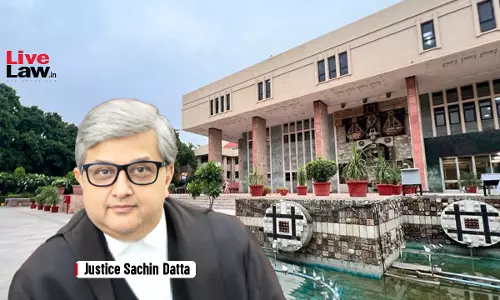
Intent Of S.11(6) Of Arbitration Act Is Not To Confer Jurisdiction On Courts Incompetent To Entertain Such Applications: Delhi High Court
The Delhi High Court bench of Justice Sachin Datta has held that the intent of Section 11(6) of the Arbitration and Conciliation Act, 1996 (Arbitration Act) cannot be interpreted to confer jurisdiction on a court that is otherwise incompetent to entertain an application under this provision. Brief Facts: The present petitions arise from two Home Loan Agreements dated 31.03.2018 between the petitioner and respondents. Under these agreements, the petitioner sanctioned loans of Rs....
If No Bonafide Negotiations Occur After Arbitration Notice, Period Cannot Be Excluded From Limitation: Delhi High Court
The Delhi High Court bench of Justice Sachin Datta has held that if, after the issuance of a notice invoking arbitration, no bonafide negotiations take place between the parties, and the limitation period for filing an application under Section 11(6) of the Arbitration and Conciliation Act, 1996 (Arbitration Act) expires, the time allegedly spent in such negotiations cannot be excluded while computing the limitation period under Section 11. Brief Facts: The disputes between the...
Questions On Legality Of Revival Of Arbitral Proceedings To Be Adjudicated By Tribunal U/S 16 Of A&C Act: Delhi High Court
The Delhi High Court bench of Justice Manoj Kumar Ohri, while hearing a writ petition challenging the decision of Delhi International Arbitration Centre (Respondent No. 1) to revive arbitral proceeding after closing the proceedings due to non-filing of the State of Claim (SOC) observed that since the proceedings have been revived, the Arbitral Tribunal is the competent authority to adjudicate and rule upon. Facts: The petitioners and Respondent No. 3 were in a business relationship....
No Damages For Loss Of Profit In Absence Of Proof Of Missed Profitable Ventures Due To Delay In Contractual Payment: Delhi High Court
The Delhi High Court bench of Justices Vibhu Bakhru and Tejas Karia has held that unless it is demonstrated that the delay in payment for the completion of the work contract prevented the contractor from undertaking other profitable ventures, damages for loss of profits cannot be awarded. Brief Facts: The impugned arbitral award arose from disputes under a contract dated 29.08.2011 for Package-III Electrical Services at AIIMS, Patna, under the PMSSY scheme. The Arbitral Tribunal...
Waiver To Section 12(5) Of Arbitration Act Has To Be Given After Constitution Of The Tribunal: Delhi High Court
Th Delhi High Court Bench of Justice Jasmeet Singh has observed that the party giving no-objection to the applicability of Section 12(5), Arbitration and Conciliation Act, 1996 (“ACA”) has to give such no-objection after the constitution of the Arbitral Tribunal. The waiver to applicability has to be done after the arbitrators are appointed with the names and details. The Court also observed that any waiver before the constitution of the arbitral tribunal is no waiver in the eyes of law. ...
Limitation For Application U/S 11(6) Of Arbitration Act Can't Be Bypassed By Claiming Advocate Was Not Authorised To Issue Notice: Delhi High Court
The Delhi High Court bench of Justice Jyoti Singh has held that the bar of limitation for filing an application under Section 11(6) of the Arbitration and Conciliation Act, 1996 (Arbitration Act) seeking the appointment of an arbitrator, cannot be circumvented merely on the ground that the demand-cum-arbitration invocation notice was issued by the petitioner's counsel without proper authorization. The court held that such a contention, if accepted, would render the limitation period for...
Arbitrator's Decision To Choose Internationally Recognised Formula Based On Expertise For Computing Damages Can't Be Faulted: Delhi High Court
The Delhi High Court bench of Justice Manoj Kumar Ohri has held that different formulae may be applied depending on the circumstances, and the choice of method for computing damages falls within the arbitrator's discretion. Sections 55 and 73 of the Indian Contract Act, 1872 (Contract Act) do not prescribe any specific formula for the calculation of damages. Therefore, the arbitrator's decision to apply any internationally recognized method, based on their expertise, cannot be faulted. ...