Supreme Court
ITC Cannot Be Denied To Bona Fide Purchasers If Seller Defaults On Tax Payment : Supreme Court
The Supreme Court recently held that the Input Tax Credit (ITC) on goods purchased from registered dealers cannot be denied to bona fide purchasers merely because the seller failed to deposit the Value Added Tax (VAT) with the government.A bench of Justice Manoj Misra and Justice Nongmeikapam Kotiswar Singh observed that there was no infirmity in the order of Delhi High Court granting credit to the respondent, a bonafide purchaser. “We do not find a good reason to interfere with the order...
Dealers Cannot Claim Input Tax Credit For Purchases Linked To Exempt Sales Under UPVAT Act : Supreme Court
Emphasizing that tax statutes must be strictly construed with statutory language taking precedence over policy intent, the Supreme Court, in a case concerning the Uttar Pradesh Value Added Tax Act, 2008 (“VAT Act”), held that a dealer is not entitled to claim Input Tax Credit (“ITC”) on the purchase of goods where the subsequent sale of those goods is exempt from tax.“Section 13(7) outlines the circumstances under which such a benefit cannot be allowed. Section 13(7) also sets out that no...
Supreme Court Upholds Allahabad HC Decision That Chargers Sold With Cell Phones Cannot Be Taxed Separately Under UP VAT Act 2008
The Supreme Court recently upheld the decision of the Allahabad High Court which observed that the charger sold with a cell phone under the MRP cannot be taxed separately under the UP VAT Act 2008. The bench of Justice BV Nagarathna and Justice SC Sharma was hearing a challenge to the order of the Allahabad High Court which held that a mobile charger contained in a composite package with the cell phone cannot be taxed separately under Entry 28 Part B Schedule II U.P. VAT Act 2008. The...
Benefit Of Input Tax Credit Can't Be Reduced Without Statutory Sanction : Supreme Court
The Supreme Court recently held that Rule 21(8) of the Punjab Value Added Tax Rules, 2005, which was notified on January 25, 2014, could not be applied to transactions before April 1, 2014, as the enabling amendment to Section 13 of the parent statute, the Punjab Value Added Tax Act, 2005, was effective from that date.This means businesses that bought goods at a higher tax rate before this date are not subject to the limitation imposed by Rule 21(8) when claiming ITC, even if the tax rate was...
Gujarat Value Added Tax Act | 'Purchase Price' Definition Doesn't Include Value Added Tax : Supreme Court
While Interpreting the definition of the 'Purchase Price' under the Gujarat Value Added Tax Act of 2003 (“GVAT”), the Supreme Court on Friday (August 2) observed that the value-added tax would not be included in the definition of the purchase price. The Court held that no value-added tax would be added to the purchase price to calculate tax as the same is not mentioned in the categories of tax/duties enumerated under Section 2(18) of the GVAT. “The purchase price, therefore, would be the...
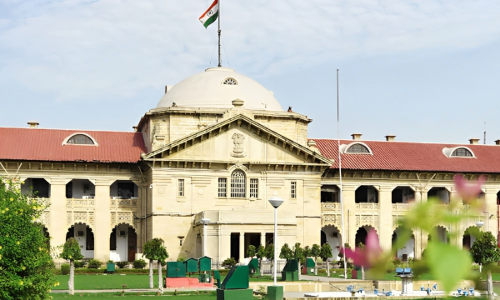
S.16 UPVAT Act | Invoices, RTGS Details Not Sufficient For Deciding ITC Claim, Transportation Details Must Be Produced: Allahabad High Court
Placing reliance on the judgment of the Supreme Court in State of Karnataka vs. M/s Ecom Gill Coffee Trading Private Limited, the Allahabad High Court has held that input tax credit cannot be granted based solely on invoices and RTGS payment details.While dealing with Section 70 of the Karnataka Value Added Tax Act, 2003 the Supreme Court in M/s Ecom Gill Coffee Trading Private Limited held that burden to prove that claim for input tax credit and the genuineness of the transaction lies solely on...
Hiring Of Motor Vehicle Or Cranes Is Not 'Sale Of Goods' If Control Over Equipment Is Retained By Contractor, VAT Can't Be Levied: Supreme Court
The Supreme Court has held that the hiring of motor vehicles/cranes from a contractor is a service and would not attract Sales Tax or Value Added Tax (VAT) assuming the transaction to be sale of goods. The Court clarified that transfer of right to use the goods not only includes possession but also control over goods by the user. If the control over the goods remains with the contractor during the hire period, then it cannot be termed as sale of goods and only service tax can be levied. The...
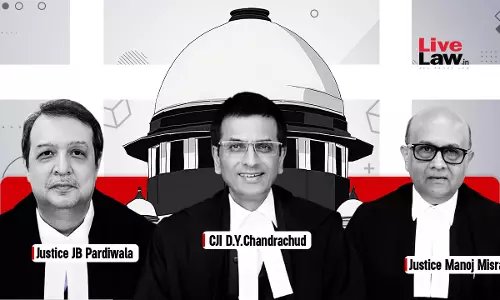
UP VAT Act | Definition Of “Goods” Under Sec. 2(m) And Sec. 13(1)(f) Includes Taxable As Well As Exempted Goods: Supreme Court
The Supreme Court has held that the definition of “Goods” under Section 2(m) of Uttar Pradesh Value Added Tax Act, 2008 (“UP VAT Act”) includes both taxable as well as exempted goods. Similarly, the word “goods” under Section 13(1)(f) of the UP VAT Act cannot be said to be qualified by the word “taxable”.The Bench comprising the Chief Justice Dr. Dhananjaya Y. Chandrachud, Justice J.B. Pardiwala and Justice Manoj Misra, has held that the legislative intent behind the 2010 amendment to the UP VAT...
UP VAT Act | Assessee Entitled To Claim Full Input Tax Credit On Exempted Goods Produced As By-Products Or Waste Products During Manufacturing Of Taxable Goods : Supreme Court
The Supreme Court while relying on Explanation (iii) to Section 13 of Uttar Pradesh Value Added Tax Act, 2008 (“UP VAT Act”), has held that if during the manufacture of any taxable good any tax exempted goods are produced as by-product/waste product, then it shall be deemed that the goods purchased from within the State for such manufacturing have been used in manufacture of taxable goods alone. Thus, the Assessee would be entitled to claim full benefit of Input Tax Credit (“ITC”) in respect of...
State Amendments Made To VAT Acts After GST Came Into Effect Are Invalid : Supreme Court
A Division Bench of the Supreme Court, while deciding the appeals arising from judgments of Telangana, Gujarat and Bombay High Court with respect to the validity of VAT Amendment Act in their respective states, made several significant findings regarding Section 19 of the Constitution (101st Amendment) Act (Amendment), 2016, which allowed the introduction of the Goods and Services Tax.Inter-alia, the issue was about the legislative competence of the State enactments after 01.07.2017 i.e. beyond...
Mortein Spray, Harpic & Lizol Cleaner- Not Classifiable as ‘Insecticide’ Under KVAT; Dettol A 'Medicament': Supreme Court
The Supreme Court bench comprising Justices M. R. Shah and Krishna Murari has ruled that Mosquito Mats, Coils and Vaporizers, Mortein Insect Killers, Harpic Toilet Cleaner and Lizol Floor Cleaners, are not be classifiable under Entry 44(5) of the 3rd Schedule to the Kerala VAT Act (KVAT), 2003 as ‘insecticides’.While observing that Entry 44(5) of the 3rd Schedule to the Act is a general entry, the bench observed that the said products would fall under Sl.No.66 and 27(4) of...
KVAT Act | Dealer Claiming Input Tax Credit Must Prove Transaction Beyond Reasonable Doubt : Supreme Court
The Supreme Court has held that under Section 70 of the Karnataka Value Added Tax Act, 2003, a dealer claiming Input Tax Credit on purchase ought to prove and establish actual physical movement of goods and genuineness of transaction. It noted that in order to establish the same, the dealer should furnish the name and address of the selling dealer, details of the vehicle which has delivered the goods, payment of freight charges, acknowledgement of taking delivery of goods, tax invoices and...