
Legal Heirs Not Assessees Under Service Tax; Proceedings Abate After Death: Orissa High Court
Manu Sharma
17 Jan 2026 2:43 PM IST
The Orissa High Court has recently held that legal heirs of an individual service provider cannot be treated as assessees under the service tax law and that proceedings abate upon the assessee's death even if a show cause notice was issued earlier.
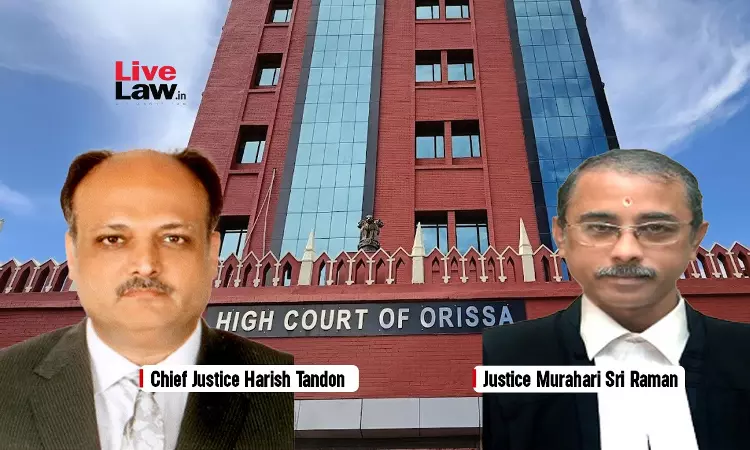
A Division Bench of Chief Justice Harish Tandon and Justice Murahari Sri Raman set aside a service tax demand raised against the deceased assessee, observing that the Finance Act, 1994, does not authorise the tax department to proceed against legal heirs for liabilities allegedly incurred by a deceased individual.
"It is, thus, deduced from the above discussions that ―legal heir‖ cannot fall within ken of Section 65(7) of Chapter-V of the Finance Act, 1994 so as to proceed further to determine service tax under Section 73 of said Act after the death of service provider. In other words, on the death of the service provider, in absence of statutory provision empowering the authority to continue further, the proceeding under Section 73 would abate.,” the court held.
The court was hearing a writ petition filed by the widow of the deceased, challenging the Order-in-Original passed by the Assistant Commissioner of GST and Central Excise, Bhubaneswar-II Division.
The show cause notice had been issued on December 30, 2020. The order subsequently confirmed a demand of service tax amounting to Rs 17.92 lakh along with interest and penalties of Rs 18.12 lakh for the financial years 2015-16 and 2016-17, even though the assessee had died on June 4, 2021, and his death had been formally intimated to the department.
According to Section 65(7) of the Finance Act, 1994, an “assessee” means a person liable to pay service tax and includes his agent.
The court observed that a legal heir does not fall within either limb of this definition. It noted that an “agent” is one who is authorised to act on behalf of another during that person's lifetime, and that legal heirs cannot, by reason of succession alone, be treated as agents of the deceased for the purposes of tax liability.
The court further noted that unlike income tax law, which contains specific provisions enabling assessment and recovery from legal representatives, the service tax law contains no such machinery provision. Relying on the Supreme Court decision in Shabina Abraham v. Collector of Central Excise and Customs, the bench reiterated that taxing statutes must be strictly construed and that courts cannot supply omissions by implication.
It thus held that on the death of the service provider, in the absence of a statutory provision empowering the authority to continue further, the proceeding under Section 73 would abate.
Consequential recovery initiated under Section 87 was also held to be unsustainable.
Accordingly, the High Court quashed the adjudication order dated August 30, 2024, and the subsequent recovery notice/
Case Title: Kanakalata Senapati v. The Assistant Commissioner, GST and Central Excise & Ors
Citation: 2026 LLBiz HC(ORI) 5
Case Number: W.P.(C) No. 29819 of 2025
For Appellants: Senior Advocate Rudra Prasad Kar
For Respondents: Advocate Mukesh Agarwal, Junior Standing Counsel