
Karnataka High Court
RERA Orders Not Decrees, Cannot Be Executed Through Civil Courts: Karnataka High Court
The Karnataka High Court has recently ruled that an order passed by a Real Estate Regulatory Authority (RERA) does not amount to a civil court decree and cannot be executed through civil execution proceedings, holding that RERA orders must be enforced only through the statutory recovery mechanism provided under the Act. A single bench of Justice M Nagaprasanna said the statutory scheme shows that RERA is a 'self-contained code' whose decisions do not conform to any of the requirements of a...

Karnataka High Court Restores Classic Legends' Rights To The 'Yezdi' Marks For Motorcycles
The Karnataka High Court has recently allowed a series of appeals filed by Classic Legends Pvt. Ltd. and its founder, restoring their right to use the 'Yezdi' name and logos for motorcycles. The judgment overturns a 2022 decision that had declared the marks to be the property of Ideal Jawa, the defunct manufacturer of the original Yezdi bikes.A Division Bench of Justice D K Singh and Justice Venkatesh Naik T held that the single judge had erred in concluding that Ideal Jawa continued to own the...
Karnataka High Court Orders Refund Of ₹10 Crore, Says Payment During GST Search Was 'Not Voluntary' U/S 74(5) CGST Act
The Karnataka High Court held that the assessee's payment of Rs. 10 crores could not be treated as a voluntary payment under Section 74(5) of the CGST Act (Central Goods and Services Tax Act), as the DRC-03 shows 'NIL' entries for both interest and penalty. The bench observed that the 'NIL' entries clearly indicated that the payment was made by the assessee under coercion and under the threat of arrest. Justice S.R. Krishna Kumar stated that prior to the search and inspection...
Centre Cannot Retain Wrongly Paid IGST Once Correct Tax Is Paid To State GST Authorities: Karnataka High Court
The Karnataka High Court has held that the Centre cannot retain wrongly paid IGST (Integrated Goods and Services Tax) once the correct tax is paid to the State authorities. Justice S.R. Krishna Kumar observed that since the assessee had wrongly paid IGST and later paid the correct tax to the State GST, the Central government must refund IGST to the assessee. The assessee/appellant is a Science and Technology Company operating across healthcare, life science and electronics and has...
DRC-03 Payments Made During GST Search Not Voluntary; Refund Cannot Be Rejected Through Deficiency Memos: Karnataka High Court
The Karnataka High Court holds that payments made by assessee through Form GST DRC-03 at the time of search or pursuant to an investigation cannot be treated as 'voluntary payments' when amount was not determined through any formal assessment or adjudication. A Bench comprising of Justice M. Nagaprasanna, quashed deficiency memos issued by the Deputy Commissioner of Central Tax (Revenue) on two different dates rejecting refund sought by assessee. On this score, it was observed that...
Income Tax Act | Interest On Loan Advanced To Company Not Deductible Against Salary Income: Karnataka High Court
The Karnataka High Court has held that a loan raised by mortgaging property and advancing to a company does not constitute business expenditure, and the interest is not deductible against salary income. The bench opined that unless expenditure is incurred in the course of the business or professional service, the assessee is not entitled to a deduction, merely due to it being incurred on the amount borrowed and advanced to the company. Justices D K Singh and Rajesh Rai K stated that...
[LLP Act] Partners Bound To Refer Disputes To Arbitration Even Without Such Clause In Agreement Under Entry 14 Of First Schedule: Karnataka HC
The Karnataka High Court has said that Entry 14 of the First Schedule of the Limited Liability Partnership Act 2008 is in effect a statutory and compulsory arbitration, which is required to be adhered to by the partners in a limited liability partnership.For Context: Entry 14 of the First Schedule of LLP Act, 2008 reads thus: All disputes between the partners arising out of the limited liability partnership agreement which cannot be resolved in terms of such agreement shall be referred for...
Appeal Against Order U/S 39(2) Arbitration Act Is Not Maintainable U/S 13 Commercial Courts Act: Karnataka High Court
The Karnataka High Court dismissed an appeal under section 37 of the Arbitration and Conciliation Act, 1996 (Arbitration Act), holding that no appeal under section 13 of the Commercial Courts Act lies against an order passed under section 39(2) of the Act. The court further held that the appeal under section 13 of the Commercial Courts Act is maintainable against those orders enumerated under Order 43 of the CPC or under section 37 of the Act and that section 39(2) does not fall within...
When Two Or More Courts Have Jurisdiction, Parties' Choice Of Court Prevails Even If Cause Of Action Arises Elsewhere: Karnataka High Court
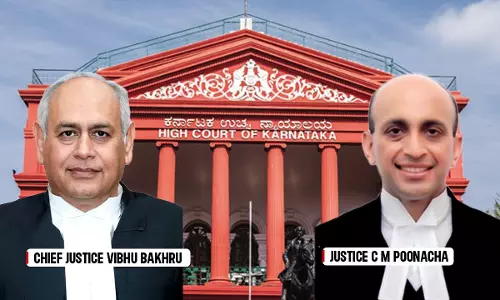
The Karnataka High Court held that when parties to a contract have agreed to exclusive jurisdiction of a particular court, suit instituted in other courts is not maintainable even if the cause of action has arisen in other jurisdiction. Setting aside the interim injunction granted by the commercial court at Bengaluru, the Division Bench comprising Chief Justice Vibhu Bakhru and Justice C.M. Poonacha held that the Debenture Trust Deed (DTD) clearly conferred exclusive jurisdiction on a...
Lease Renewal Disputes With PSU's Are Arbitrable If Not Related To Eviction Under Public Premises Act: Karnataka High Court
The Karnataka High Court held that renewal of lease agreements with public sector undertakings are arbitrable and such disputes are not prohibited under Public Premises (Eviction of Unauthorised Occupants) Act, 1971 (PP Act) when lessee continues in possession lawfully and the rent is being accepted by the lessor. Accordingly, the present application under section 11 of the Arbitration and Conciliation Act, 1996 (Arbitration Act) seeking appointment of a sole arbitrator was allowed. ...
Mens Rea Not Prerequisite For Imposing Penalty U/S 117 Of Customs Act: Karnataka High Court
The Karnataka High Court held that mens rea is not a prerequisite for imposing a penalty under Section 117 of the Customs Act. Section 117 of the Customs Act, 1962, addresses penalties for contraventions not specifically mentioned elsewhere in the Act. Justices S.G. Pandit and K.V. Aravind stated that a plain reading of Section 117 of the Act makes it clear that whenever any person contravenes any provision of the Act or fails to comply therewith, a penalty is attracted. Reading a...
Tax Demands Raised Post Approval Of IBC Resolution Plan Are Not Enforceable: Karnataka High Court
The Karnataka High Court recently reiterated that tax demands raised by revenue authorities after the approval of a resolution plan under the Insolvency and Bankruptcy Code (IBC) are unenforceable if the claims were not submitted during the Corporate Insolvency Resolution Process (CIRP).A single bench of Justice M Nagaprasanna observed,“There is no jurisdiction to parallelly initiate proceedings and raise a demand. In the light of CIRP becoming moratorium kicking in resolution plan...